Solo /Fitness / Jun 24, 2022 · 27 min
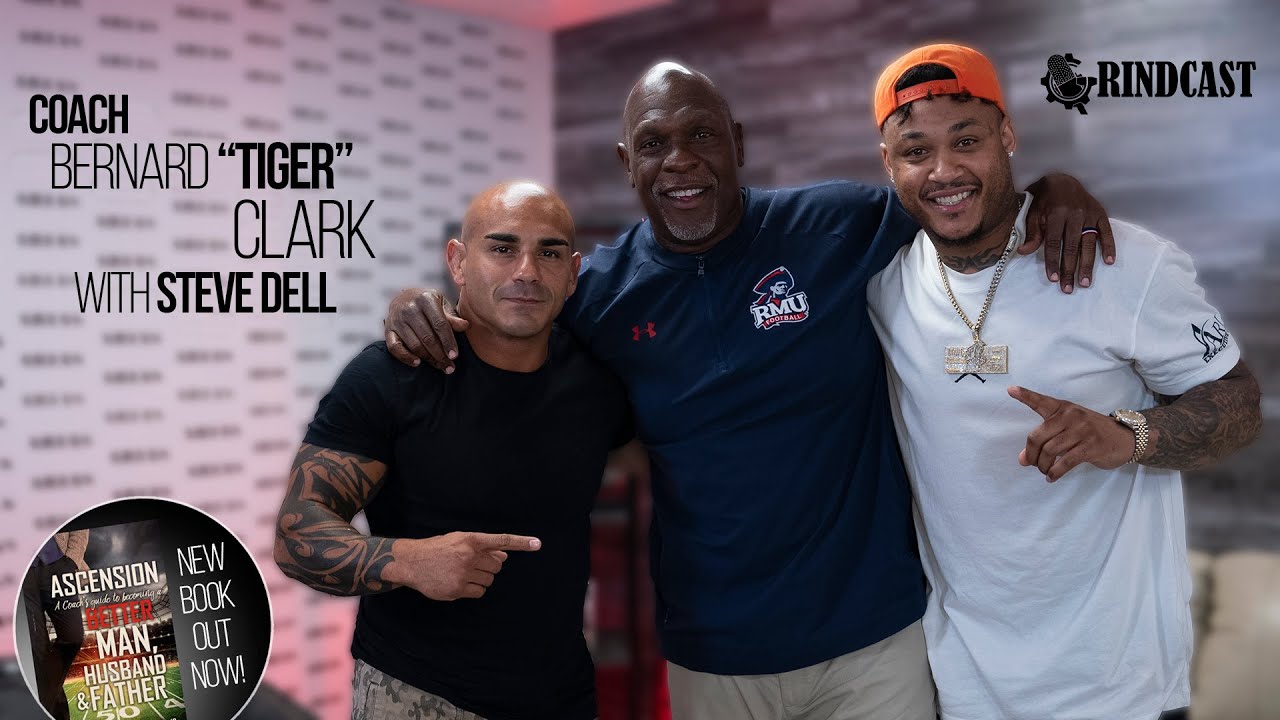
Special Guest, Coach Bernard “Tiger” Clark
Show notes
This week we have on Head Coach of Robert Morris University Bernard “Tiger” Clark. Coach Tiger has a football career spanning over 30 years starting off as a championship player for the Miami Hurricanes.
Get Coach Tiger’s new book, “Ascension” here https://amzn.to/3OtbA3g
Transcript
Count money, man.
Money, man.
I'm trying to talk to my beast.
What's up, gang?
Welcome back to another episode of The Grindcast.
Get ready.
It's a new day.
We got the boss man, coach Robert Morris.
Head coach, Robert Morris here is a special guest, Bernard Clark, AKA Tiger.
We got Rambo Del, Steve Del in the house also.
So let me give you just a quick background on, if I could, coach Tiger.
Can I call you coach Tiger?
I coach Tiger.
All right, coach Tiger, we have Orange Bowl MVP, two time championship player at Miami.
That's I'm assuming the hurricane's former player for the bangles and the Seahawks.
Current head coach at Robert Morris University.
And also, I know that you also have a, a book out because I got that right right behind
us.
The, the ascension, the coach's guy to becoming a better man, husband and father, which
is, which is, which is what I've
got, tried to do for people that follow me and people have done that for me and changed
my life.
So I know a lot of people are being impacted by you.
You were a two time national championship player at the University of Miami.
Absolutely.
Is that right?
Okay.
I'm going to float.
It's not going to mix with Ohio.
Yeah, yeah.
Not the Red Hawks.
Not to Miami.
Okay.
Not to Miami people.
How did it mix up?
This is the you.
The you, the Army fatigue, my curve.
I got it.
And then, P at the Orange Bowl, that don't happen too often and played linebacker for
the bangles and the Seahawks.
And so, you know, when I, when I go through all of that, you know, people see all of the
good stuff, all of the championships, Orange Bowl and all that and, you know, what, what
drives me, used to drive me crazy or because of the work that goes into it is when people
would say, oh, man, it must be nice to be able to, you know, do that must, must be nice.
But there's a lot of things that people miss in the process of becoming a head football
coach or in the process of what happens before winning an MVP of an orange ball.
What happened in the dark?
And so what would have been maybe some of the work, some of the things that go into the
wins and the things that you've done in life?
What are some of the behind the scenes things that it takes?
What the biggest thing I always tell people, when I was in the University of Miami, there
was a sign and a sign went from the training room all the way to the locker room.
And what the sign said was preparation plus opportunity equals success.
And I read that sign every single day and that was my mindset.
Not only as a football player, but also as a man.
But as a football player, when I got the opportunity to start in the national championship
game in the orange ball in 1988, I was 19 years old.
It was a sophomore.
But I was prepared for that opportunity because that's why I read all day long when I was
there.
I was in the preparation now.
Steve and I were talking about it downstairs.
The thing that's important is, is can you be committed to the process?
Oh, come on.
When I've been in most of the attacks to the results because we know the process works.
That's what Inca Johnson, I got the quote from Inca Johnson.
We know the process works and everything that you do because you know, and I know football
has groomed us to be in who we are.
Football taught us discipline.
It taught us relentlessness.
Trust, honesty, dedication, all those things going to be in a successful man in life.
And that was the reason, biggest reason for the book, more than anything else.
Amen.
So coaching young people, young people, which we were all at one point, right?
So we can relate what I love about studying coaches, my mentor and close friend of mine,
like a father to me is Jim Tressel.
And I look back and when I study him, it was cool as your coach in 18 to 23 year olds,
consistently, over and over again at a pivotal point in their life.
But usually that point in your life doesn't give you a lot of focus for everybody.
That's where a coach comes in and can groom that and pull that out of you, is the ability
to commit to a process without seeing the immediate result.
How have you been able to groom that or coach people through that?
Because sometimes you get players right out of high school and they're going to start as
a freshman.
Absolutely.
And sometimes you get the player in high school that was a dog in high school and was all
everything.
And he ain't going to start till he's a junior.
How do you keep that person committed to the process?
I think what it boils down to is my mission statement as a coach, and since I've been in
it and my mission statement as a head coach is we're creating an environment on an awful
football field to continue what families have done and help these guys become better men,
better husbands and better fathers.
So we got to help them understand you got to be dedicated to the process.
Let's say a young man comes to me after his freshman year, he says, Hey coach, I want
to go to transfer a portal.
I'm going to look at him and say, Okay, why?
You haven't even experienced college yet.
And the conversation I have with you and your parents, you guys told me how important
education was.
So why are you transferring?
Are you transferring because you want a better education?
You transferring harder?
Are you transferring somewhere where you're trying to play more football?
Let's understand that this is a process that you have to go through.
We're creating a better man, better husband, better father because of the process.
It's a grind.
It may not happen for you right away, but you cannot be discarded or discouraged by the
results of what's happened.
The biggest window that you see in that process with the athletes, is it, would you say,
is the freshman year, the first year?
Is that the biggest one?
I don't think there was one.
All of us, may all of us play a college football.
You come in and you're the first one.
The first one.
You're going to miss mom and dad.
The first year is the toughest.
Absolutely.
They know that.
I mean, you get to camp.
There's no guys in camp.
Miss your girl.
Extra bad.
You know girls on campus and nothing on that is just you should have come to the team.
In a different area.
It's just football.
You're setting the playbook.
You got the coaches in your ear.
You're away from home.
And now you got these coaches constantly in your ear screaming at you every day.
You're trying to get somebody.
Like you said, and if you were the man in high school and now these coaches are on you and
you may not play.
Carry the water bottles for us there.
Because I was registered.
Just like you were registered.
I think you were registered.
Yeah.
So you go through all the work.
Yeah.
My high school.
None of the pay off of my high school is horrible.
I mean, I don't think last time we had a winning season in my high school was 1993.
I mean, it's still going on.
Great teachers, great people, but the school's sports was horrible.
So when I got there and I was the guy in high school, so when I got to college and I wasn't
the guy anymore, I'm like, what's going on?
So I went to coach Johnson.
I'm like, hey, coach, what's happening?
He said, oh, we're going to register.
You know, so those y'all are to listen and you know what he means by Johnson, coach Johnson.
Yeah, Jimmy Johnson.
Jimmy Johnson.
So if you're young and you don't know, you got to Google Jimmy Johnson.
He got to play for one of the greatest coaches of all time.
Some consider him the greatest.
I mean, just amazing things.
He went on to accomplish with the Cowboys, Dallas Cowboys and all of that.
This is the protégé.
This is where we get to see somebody that actually played for matter of fact while we're on that subject,
we think stand out to you about coach Johnson.
Oh coach Johnson.
The one thing I learned from coach Johnson, I tell my players, it's all the time, coach Johnson
walked in the meeting room and he says, you're going to be treated fairly, but you would
not be treated equal.
What does that mean?
If you're on this team and you're late to a meeting, you're going to do the same amount
of up-downs and starter going to do.
You don't show up to the bus on time, the bus is going to leave you just like he's going
to leave a start.
But on the field, the starters are going to be able to make more mistakes.
So starting running back from being able to fumble the ball and then the first quarter
they still get back in later on.
The second team running back, not going to be able to fumble the ball and the first quarter,
because you're going to be on the bench.
Fair but equal.
That helped me understand the relationship that you had on the football field based on
your talent.
And the results.
And you know, and I know talent equals tolerance.
They're going to tolerate more if you are starter than if you're not a starter.
So fair but equal.
That's the first thing I learned from coach Johnson.
That's one thing I try to instill in my guys because that's life.
That's life.
That's how life is.
I mean, if you're the top salesman at your job and they're laying people off, you're not
going to get laid off.
Right.
No worry about it.
They're going to worry about it.
Other people going first.
Some of the people that ain't getting it done showing up the weight late.
You may not be there as much.
That's what it's all about.
Something I grab right here just from the camp.
You know, young people listening out there, young athletes listening out there.
I wanted to quit my first year of college.
I was looking at the transfer.
I'm taking places.
I ain't playing.
I went from state title to not playing in the cold in eerie freezing and winning that
mental battle to understand when you went into high school as a freshman, we got to start
that process over again a little bit.
We got to prove ourselves.
Everybody had some accolades.
Right.
So we're coming through and I want to encourage you, you know, that the people that quit
are typically the ones in that first year.
If you could just stick it out that first year, that first year, over time, it gets better
and better and better and better.
Everything that stands out to me personally that came with greatness, I've thought about
quitting at least in my mind.
I just never told nobody.
I thought about man, let's stop running these sprints.
Let's stop playing balls too hot.
All my friends are kicking it in the summer.
Man, I ain't playing.
I'm short the next two dudes above me or junior and a sophomore, six foot one, how I'm
going to get on the field.
You start creeping out into your mind.
Marriage gets hard to think about, oh man, maybe I'd be better off.
Maybe I'd be better off single.
Anything great in life, the beginning front side of that, is you got to talk to yourself
out of quitting when it's tough and when it's difficult.
And how do you do that?
You got to be committed to the process.
To the process.
That's the plain and simple without being emotionally attached to the results.
Because when your emotions get involved, up and down, up and down, we just told you
guys, I gave my life to Christ in May of 96.
Come on.
Well, May of 96 when I gave my life to Christ before that, I would feel a certain way, act
off of those feelings and think about the consequences later.
But after I gave my life to Christ, I would think about everything that could happen if
I did this, if I did this, if I did this, then I would act and I would feel a whole lot
better.
How big of a role do you think that your faith has played in your success and coaching
really helps you find out where my purpose was?
This is my purpose.
It's not just about me being a head coach.
I'm not stuck on the platform.
Platform is not important.
The platform is never going to be more important in the purpose.
The purpose is the created environment to help these guys become better men but husband
and better fathers.
So it's everything.
I mean, as though God gave me a purpose of exactly what I needed to do as opposed to just
doing a job.
You know, I was a car salesman.
And there were months I made 2000.
There were months I made 15,000.
So money wasn't what was driving me because there was my life.
I don't feel like doing this this month.
But there ain't a day I don't wake up.
I don't feel like doing that.
That's something like doing that.
The day I don't wake up, I don't feel like going on that field and helping them young
men understand what's going on.
You know, there are days they drive me crazy.
I love them.
I love them but I ain't got to always like them.
I'm not.
I'm a bastard.
I'm not.
I'm not.
I'm not.
I'm not a kid but they always love me and they always cared about me.
I'm always loved these guys but there are days I go out there.
I want to get after more.
There's never a day I go into that field like man, I want to be on this field.
So I want to come back to that national about loving them and still hold them accountable.
But let me ask Steve, you coached together.
Did y'all coach together?
Yes, yes, no doubt.
Where did y'all coach together at?
Tell me what you grabbed from him, what you saw on him when you guys were there.
Well, first of all, I'm back on the grind cas.
Welcome back.
Let's go.
Let's go.
Appreciate it.
Appreciate it.
But also appreciate coach Tiger.
Obviously, it's crazy because it's so important.
It kind of makes like a full circle.
Like, we talk about mind body and spirit all the time in this organization and I didn't
really understand that until it was putting those type of words but that's where it started
when I met with Matt Tiger at Pitt.
So where did we first meet?
The question was, we met at Pitt.
I had came back and then we kind of gravitated towards each other.
I played linebacker E. Coach with Dave Wants that.
Jimmy Johnson was with Dave Wants that.
So that was huge because all the things that you're saying about Jimmy is the things that
Wants that said.
But I ended up being able to be a graduate assistant for Coach Tiger in 2010.
I think that was 2010.
And what I grabbed is what I was talking about with the mind body spirit, the spirit aspect.
And you too, it's crazy because in my life, I would probably say you too are the most of
that as far as my spirit aspect.
And when I first met you, when I first met you, I knew you were all into your spirit.
And trust me, we got to create, we got to store me.
And me and Simon got to store, we've already told that I knew he was in this spirit.
But we met.
So, you know, that was, that's something that when I come back and I think about it full
circle, this is the reason why I wanted to make this happen and be a part of it.
Not make it happen, but be a part of it because I know that that's something that's very important
to me right now in my spirit.
Love it.
And to have two guys who were being able to mentor me in that area, that's huge.
So I appreciate both of you guys.
Appreciate you, Coach.
One of the biggest things you can give these young guys, your coaching, even if it's
on accident, they pick it up just by watching how you roll.
No doubt.
Just be a light.
Yeah.
And then what I really, you know, when I think about it, what did I learn from Coach Tiger
because man, he can come with a lot as far as what I've learned.
I've seen him, I've seen him, but in his, in his, my experience with him in the coaching
world is, and why I think it will lay down down the road when it comes to just business,
is his, his being able to cope, being able to become cool and collective under any circumstance
throughout the time that we've been coaching.
I was talking about that with him earlier.
Not emotionally attached to the results.
Let me do it.
Result, man.
And I still show emotion.
Don't get me wrong.
I still have passion for what I do.
Oh yeah, he's still a dog.
Got to bring that.
He's still got that dog check in him.
Remember that dog check.
But, but he was, he was, you know, I think about that now and how we're always trying to
relate back to what helped us become who we are today.
And I just know that the reason why a lot of people aren't successful, it's not because
they're not talented.
Right.
It's because they don't know how to cope.
They don't have people like you or Simon in their lives that can say, hold on, wait,
this is how you need to cope with this.
you need to be concoup.
And so you got guys out,
and I thought about this as I was driving.
You got guys out here making decisions,
whether that's some happens in their personal life,
they go home, they go on a car
or they go home, some happens, they shoot their girlfriend.
Like something happens,
but nobody is there to be like, hold on.
Call out to cool and collective and those decisions.
And I've learned that until today,
you probably obviously noticed,
but that was something that when we were out on the field
of play, we would come back to the sideline and I,
and he knows I'm an emotional person.
Ah, he's like, hold on, make sure he knows
what to do in this situation.
And then what we're gonna tell him is that,
it's all right, it's cool.
We know we messed up on this play,
but we're gonna get to the next one and we're gonna be all right.
And we got this, it's another down, another play.
Stay in cool, stay in cool.
Stay in calm when you need to stay calm.
Bring in energy, when you need to bring energy.
And that's what both for you guys do very well.
And I'm still learning that.
I'm still learning how to,
because I'm such a emotional, raw, raw person
that sometimes you gotta learn how to,
all right, this is what you need to say,
how you need to say when you need to say it.
And just to be honest, yeah, that's something that
I've had to work on throughout my time.
I feel like I'm doing that a bit.
We're all still growing up.
They're still growing up.
When I was young, I went through the same exact thing
he's talking about.
I always tell my players, the reason I played two years
in NFL and I didn't play 10.
Well, then I didn't have the ability.
It's like Steve just said, I had a talent.
That's how I got there to begin with.
And I felt that's what could keep me there.
But when I got there, I refused to become a student of the game.
I refused to learn how to study the playbook, study the opponent.
I'm not talking about knowing my plays.
I didn't know what the corner did.
I didn't know what the safety did.
I didn't know what this formation told me that formation.
You don't get to be great.
You don't get to play at that level for five, six, seven, eight, nine,
ten years by just being.
I'm talented.
You got to do the extra.
You got to do the extra.
Now I didn't do that because I was, again,
I was in most of the tests to the results.
Like if I played hard and did what I was supposed to do,
I'm supposed to start.
Well, now that ain't how it goes,
because you don't know the playbook.
Yeah, this guy may not be as talented,
but this guy knows what we're doing.
He knows how to make checks on the field.
He sees a certain formation and doing that.
The same thing when he's young athletes right now.
A lot of you got to talent,
but you don't want to be a student of the game.
You don't want to learn the game.
You want to grow with the game
because you think your talent's going to take you through.
And then everybody's told you that ever since you were six.
Right.
You're going to the NFL.
You're going to do this.
You're going to do that.
Yes.
And you love the process.
You might do that, but once you get there,
yeah.
Once you get there, it's a whole other ramp.
So it took me a while to get back with you.
Speaking of taking a while.
You know what, you know, you've coached,
and I know this is the coaching world.
You know, my really, really close friend
is the offensive coordinator at Iowa State Tom Manning.
Okay.
My other close friend is Brandon Staley
head coach for the LA Chargers currently right now.
His twin brother Jason was my roommate
with Play College football together.
And it's I've watched the journey probably
know my our defense coordinator then Dave Plungers.
I don't know.
Okay.
Okay.
That's why I said, okay.
Yeah.
And our our O coordinator in college is the same
Lambertie Joe Lambertie was as is the O coordinator now
with the Chargers also.
So I just follow you root for your boys, right?
So I follow the journey and been around the game.
You know, and so I know that to be a head coach
or to continue to progress in the coaching world,
typically there's a couple of jumps and moves.
And you don't get to just work directly with the team
you want to work with right now.
There's a little bit of jumping around it happens.
And so I think, you know, I looked on there
and from your start, you know, I think you've coached
that, you know, eight, ten different teams.
Yes.
Yeah.
Moved around a little bit, you know, and all of that.
So tell us about, you know, what what people don't see
in that process over 20 years, you know, whatever.
Well, the important thing, the important thing about what you just
said is that you learning, you grow wherever you are.
That's what it boils down to.
A lot of people stop somewhere and they're upset.
They're there.
So they don't learn it.
They don't grow.
Because it doesn't matter if you like it.
I'm going to wait till I'm a head coach and then I'm
going to have a positive attitude.
Right.
Trust me.
Give me your head coaching job and watch how positive my attitude
is.
Yeah.
Yeah.
But a hundred more problems.
I'm going to learn something.
Even if I was at a place where I didn't feel a coach was doing it
the right way rather was the deepest corner of the head coach,
then matter what I thought, this is this man's job.
It's my job as an assistant coach to see him succeed.
Because if he succeeds, then I succeed.
That's how you look at it.
And you got to learn everywhere you grow.
And I wrote about it in my book, changes inevitable.
Growth is a choice.
Things are going to change.
There's nothing you can do about that.
But are you going to grow with those changes?
And I chose to grow with those changes.
So each stop I had, it's James Madison at Liberty, FIU,
USF, Hampton University.
I learned something and grew some from each difference of coordinator,
from each head coach, from me, offensive coordinator,
how he organized this, how he organized.
Till this day, I still learned something.
Let me ask you this.
How do you handle working with because on the climb,
maybe until you to head coach, you may have loved a lot of the coaches
that you worked with and worked for.
But have you ever had the opportunity, we don't need to say their names.
Have you ever had an opportunity where maybe you were working underneath
somebody that you didn't just love.
But how do you still learn from that?
Because you can learn from the good and you can learn from the bad.
You learn from the bad, right?
It doesn't make a difference if I like you as a person.
I don't even like you.
Are you good at your job?
Are you doing certain things a certain way?
I mean, like the way you have this structure.
You let me have practice structure to the point where it's,
man, it's practice right on point.
This is something I'm going to put in my little head coach and panel.
I'm going to put that down.
That's what I'm going to do.
So it has nothing to do with me liking you with this,
like, or you good at your job.
So the guys that I met, if they weren't good at their jobs,
okay, but it does this right.
He knows how to do this.
He knows how to break through.
We can't uphold from it.
Exactly.
You got to pull something from.
You can't just sit there and not learn.
I mean, if you stop learning, you just stop growing.
That's what it boils down to eat.
You got to always learn.
That's why the book is called Ascension of Coach's God to become a better.
You can always be a better man, a better husband, and a better father.
You can always be better at what you're doing.
I can always be a better coach.
Right.
Always be a better salesman.
Always be a better teacher, host.
You're always honing your craft, always sharpening your tools.
And that's what it boils down.
So that's how I learn.
How important do you think it is in your career to have the right spouser person that you
choose?
Oh, man, that's my wife, my rock.
There have been times where I've gotten fired.
And I'm like, even when we were pitting, we wanted,
we wanted a conference championship.
I'm on the road recruiting and we get fired.
Part of the game?
Part of the life?
Yeah, so I called my wife and got fired there.
And next year I go to Colorado State, we get fired again.
So I remember sitting down.
I'm like, done.
I got to be fine.
I'm going to come truck driving.
I'm going to come do something else that has most ability because I'm putting her through
this.
My wife looks like you're a coach.
That's what you do.
What a dog.
And she's like, I got this.
What a, what a unbelievable white to fight a tenant.
And I didn't work for like nine months.
She's like, go home.
I got this.
Someone's going to call you.
I'm taking care of this.
Don't worry about it.
She's my rock.
She's always been there.
So there's no doubt that she's the, I always tell people, there was a lot of women I could
have lived with.
Couldn't do this career without a woman like you.
No way you could be a head coach moving all over the place.
But I couldn't live without.
Calm, cool and collective.
Oh, there you go.
Right there.
Cut.
Because I was calling Tiger.
I was, hey, what are we going to do, man?
What are we going to do?
What are you going to do?
I got it.
You got to relax, man.
You find it's going to happen.
And I thought I think Steve got picked up by mine.
So we're going to start it with FAU with Charlie.
Charlie, Charlie, Charlie, Charlie Parches is the D line coach, the assistant head coach
now.
But he ended up getting picked up by FAU and, and I'm calling you right back to the house
at 15 minutes away.
So back, back close to his door.
That's a big one.
So it's there.
So my, so when I went back because we kept a home in Tampa, home back home in Tampa, my
wife's like, I got this, but it's important that she's there.
It's important.
Are you from that area?
I'm telling you.
I want to raise a Tampa.
I'm going to raise a Tampa.
I'm going to raise a Tampa.
All right.
All the time on the beach to go visit.
I'm going to Jamaica to get mad, but I said I'm going to go back and hang out moms down
there.
I lost my pops in 2019, man.
Mom and pops from there for 59 years.
So what an example.
Yeah, exactly.
What you give from your mom and pops that you could share with us 59 years.
You know, those are my first leaders.
You know, that always tell people, my mom told me, give everyone respect.
Now everybody say you have to earn respect.
Not true.
My mom said, you walking to a room full of women, you don't know them.
You don't start cursing the act of the food though.
You give them respect.
My mom said, you give everyone respect.
You can give a dog respect until they don't give you respect.
My mom told me that.
So I give everyone respect when I walk to room.
My dad told me, you're going to be faced with racism in life.
Unless you're on a show.
So what?
So what?
Now you can do about it.
You hit it head on, you go around and you keep moving.
My dad's like, you can't just sit and wolo.
You've done that.
That's because you haven't been faced with that.
You're going to be faced with it.
Don't worry about it.
Just keep moving.
Just keep going.
D1 football.
Absolutely.
Black head coach.
Ain't that.
Ain't that many.
Ain't that many.
That's awesome, man.
No, but it's a, it's a, it's a same way.
You did some right.
And I know victim mentality.
No excuse.
No, whatever.
So what?
And I have our face obstacles.
Yeah, man, but it's then that you can do about it.
I mean, there is racism in America.
So what?
So I'm supposed to go around and just not do anything?
Because people look at me a certain way of people.
See me in a certain.
I'm not supposed to live my life.
I'm not supposed to try to go.
I'm not supposed to be happy.
I'm not supposed to have joy because someone else does it.
So my pops taught me that, man.
And he taught it to me unconsciously.
Like he didn't realize he was teaching to me because he was going through some things.
Because he remember my pops grew up in the 40s, 50s, and the 60s.
So my pops grew up in the time where it was real rough.
Yeah, yeah, yeah, yeah.
Real rough and situate.
So my pops taught me unconsciously.
I'm not worried about that.
I'm going to work every day in my bus by behind the Delta Airlines.
And he did that for 21 years.
So that's what I saw.
I saw the whole working man coming home married to my mom for 59 years.
And they had that tough time.
Of course they did.
That's what I saw.
So that's why I got married late.
Control the control.
I got married at 35.
So I want to make sure I was silent because I'm like, I'm looking at folks being married for a long time.
You know, it can't just go in this thinking if it don't go right.
No, it's it.
Yeah, I got a great huge.
Tell me my wife Tammy's unbelievable shout out to Miss Tammy.
That's the truth.
That's that's you can't you can't do it without it.
Not the job you guys.
No, so one of my mentors, I ain't going to say who I don't want the ladies mad at him.
But I want to ask a question about coaching and high level coaching and the women or the wife for the spouse.
And he said, he said, you know what, man?
I feel this way.
I feel sometimes I would need to look at that person and say, either you got the wrong job in the right woman or you got the wrong wife, the wrong woman.
And I don't know which one it is.
That's you to decide.
But this is what the job requires.
They're not changing.
This is what it takes to be a head football coach.
My man, what it boils down to is I tell people it's all to me.
I love Miami for this and I got my 15 minutes of fame years ago.
The women that was that happened me years ago.
I got my rock next to me.
What it boils down to ain't doing nothing to shout out.
We got something strong.
It's a strong bond.
Nobody's going to break that bond.
That's what it boils down.
Love it.
Speaking of bond, you probably got a bond with a lot of different players.
You've been in a bunch of different places and I know the relationship between...